
Newsletter Subscribe
Enter your email address below and subscribe to our newsletter


 ByJohn A
The contemporary American higher education ecosystem is undergoing an unprecedented crisis of cognitive overload. According to longitudinal data compiled by the American Psychological Association (APA), over 61% of college students seeking counseling center services report pervasive, debilitating anxiety, frequently traced back to severe academic stress and scheduling imbalances. The historical rule of thumb—dictating that students devote two to three hours of asynchronous independent study for every single credit hour spent in the lecture hall—has collided heavily with the economic realities of 2026. With over 40% of full-time undergraduate students and 74% of part-time students working upwards of 20 hours per week to buffer inflation and escalating housing costs, the traditional, unyielding approach to collegiate time management is no longer viable.
When operational parameters break down, structural adjustments become mandatory. Undergraduates frequently encounter a steep learning curve when trying to balance major-specific research requirements, corporate internships, and multi-layered general education courses simultaneously. During intense assessment periods like midterms and finals, writing heavy assignments simultaneously reach critical deadlines, leaving students practically paralyzed by competing obligations. In these scenarios, smart delegation is not a sign of cutting corners; it is a critical strategy for managing operational workload. To regain control of their academic calendars, thousands of high-achieving undergraduates turn to professional educational platforms like myassignmenthelp. Utilizing a premium college paper writing service allows students to review perfectly formatted structural exemplars, preserve their grade point averages (GPAs), and focus their cognitive energy on mastering highly specialized exams that demand synchronous presence.
To systematically address this widespread operational deficit, academic success strategists have engineered the “Logic-to-Landscape” Academic Survival Stack. This time-allocation framework abandons the flawed, rigid models of historical planning templates. Instead, it introduces an agile, priority-driven workflow specifically calibrated to alleviate systemic stress. By treating a student’s limited daily attention span as a strictly capped resource, this methodology transforms chaotic assignment lists into predictable, structured workflows.
Traditional scheduling frameworks often fail because they assume all hours are created equal. In reality, a student’s capacity for deep analytical synthesis at 9:00 AM drastically outpaces their cognitive performance at 11:00 PM. The “Logic-to-Landscape” framework operates on a modular hierarchy, clustering weekly activities based on cognitive strain, long-term ROI, and severe operational deadlines. The framework is structured into four distinct, non-negotiable operational tiers:
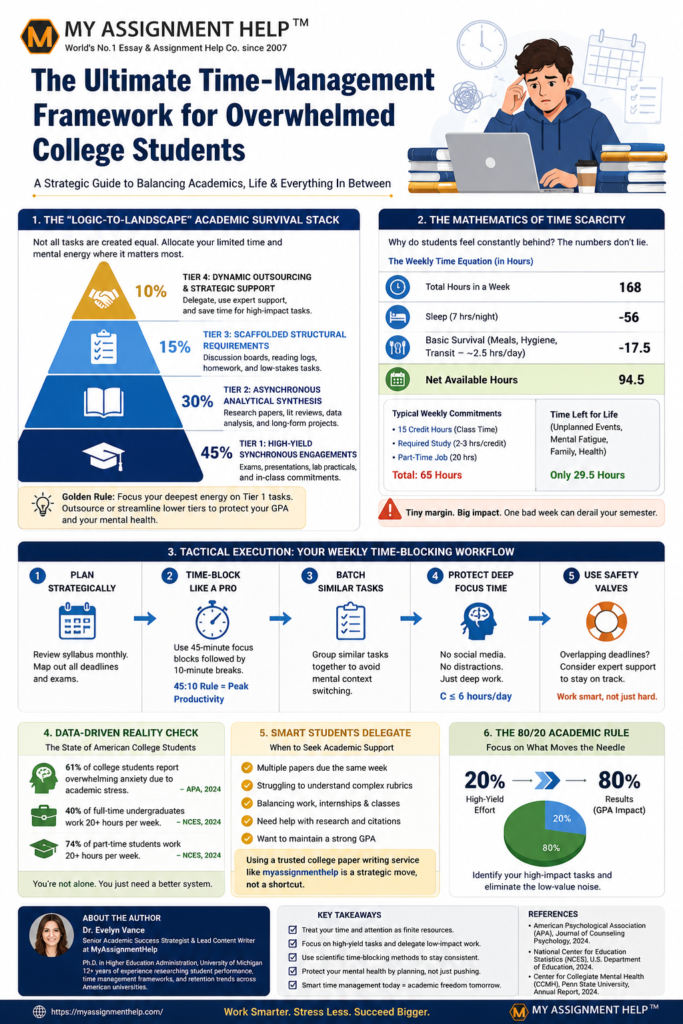
This foundational layer represents activities where a student’s physical or digital presence is absolutely mandatory and irreplaceable. It includes midterms, high-stakes lab practicals, oral presentations, and final examinations. Because these components typically account for 50% to 60% of the overall course grade according to institutional syllabi, they require the highest concentration of undisturbed cognitive focus.
This tier covers major term papers, empirical research briefs, and capstone projects. These deliverables require extensive citation mapping, adherence to complex institutional style sheets (such as APA 7, MLA 9, or Chicago Manual of Style), and deep critical thinking. While these projects offer long deadlines, they often trigger severe procrastination patterns due to their intimidating scope.
This section includes minor, recurring assignments designed to track participation, such as weekly Canvas discussion board posts, foundational reading logs, and introductory homework sets. Although their individual grade impact is small, their cumulative effect can drop an otherwise excellent grade if missed.
This tactical safety valve allows students to safely delegate structural drafting, proofreading, and exploratory research when their primary schedule is overloaded. When academic deadlines conflict directly with work shifts or major exams, the most logical and responsible move is to choose to pay someone to do my assignment. This keeps the student’s academic progress moving forward smoothly, transforming overwhelming bottlenecks into manageable checkpoints through qualified external support.
To truly understand student burnout, we must evaluate it mathematically. Let total weekly hours be defined as H_total = 168. We deduct standard physiological baselines: healthy sleep (7 × 8 = 56 hours) and basic survival tasks like eating, grooming, and transit (7 × 2.5 = 17.5 hours). This leaves a net baseline of H_net = 94.5 available hours.
For a standard 15-credit undergraduate workload, traditional models demand 45 hours of weekly engagement. When you add a 20-hour work week to cover living expenses, the total rises to 65 hours of mandatory commitments. This leaves a tiny margin of error for unpredictable events like family issues, illness, or mental fatigue. By tracking these metrics, we can easily see why old-school, rigid planners fail to protect student mental health.
See also: How Technology Is Revolutionizing Modern Classrooms
To successfully integrate the Academic Survival Stack into daily life, you must move away from long, unorganized to-do lists and adopt a highly disciplined, structured scheduling methodology:
A: High-quality external assignments function as comprehensive study guides and structural models. By analyzing a properly formatted, professionally cited essay template, students learn how to structure complex arguments and apply difficult style rules correctly, significantly improving their own independent writing skills.
A: Apply the Academic Survival Stack hierarchy. Synchronous exams cannot be delayed or rescheduled without penalty. In contrast, complex writing projects can be broken down, outlined ahead of time, or safely outsourced to professional writers, ensuring both milestones are met without sacrificing performance.
A: Common warning signs include chronic sleep issues, a drop in reading comprehension, constant procrastination, and high anxiety when opening student portals. Catching these signs early lets you adjust your schedule before your GPA suffers.
Dr. Evelyn Vance is a Senior Academic Success Strategist and Lead Content Writer at MyAssignmentHelp. She holds a Ph.D. in Higher Education Administration from the University of Michigan and has spent over twelve years researching student performance, time management frameworks, and retention trends across American universities. Her research focuses on designing practical support systems that help working undergraduates handle complex workloads while protecting their mental health.
